
Top 3 5000 watt generator Manufacturers to Watch in 2026
The Hook
Choosing a 5000 watt generator is harder than comparing headline output alone. Rated watts, starting watts, fuel type, runtime, noise, portability, outlets, warranty support, and local service can all affect whether a unit suits home backup, job-site work, recreation, or emergency preparedness. Product availability also changes by market and retailer, while a retailer’s assortment may include products from several manufacturers. This comparison reviews three supplied names—Firman, Home Depot, and PARSUN—against those practical considerations. The options have been examined through their official online positioning and the buying factors that matter most in the 5000-watt class. Because specifications vary by model, buyers should confirm the exact continuous and surge ratings before purchase.
Full List of Top 3 Brands
- Firman — A generator-focused brand with a dedicated official company website and a broad emphasis on portable power equipment.
- Home Depot — A major home-improvement retailer whose generator category provides access to multiple brands, models, and purchasing channels.
- PARSUN — A power-equipment brand with an official website covering its product and business presence.
Comparison Table
| Brand | Key Products | Key Features | Best For |
|---|---|---|---|
| Firman | Portable generators and related power equipment | Dedicated generator brand, model-based output choices, and direct manufacturer information | Buyers seeking a generator-focused supplier and a clear starting point for 5000-watt-class research |
| Home Depot | Generator products from multiple brands through a home-improvement retail channel | Retail availability, product comparison, delivery or pickup options where offered, and access to related supplies | Shoppers who value retail convenience and the ability to compare several manufacturers |
| PARSUN | Power equipment and generator-related products listed through its official business presence | Manufacturer-direct product information and a power-equipment-focused market position | Buyers evaluating an alternative supplier and willing to verify local support and exact specifications |
Detailed Reviews
1. Firman
Firman is the strongest overall entry in this comparison because it presents itself through a dedicated company website centered on generator and power-equipment activity rather than operating only as a general retail channel. Its official online presence gives buyers a manufacturer-level starting point for identifying product categories, reviewing available information, and checking which specifications apply to a particular model. The correct choice still depends on the individual unit: “5000 watt” may describe a class or rounded output figure, while the continuous rating, starting rating, engine, fuel system, outlets, and operating instructions must be confirmed in the product documentation.
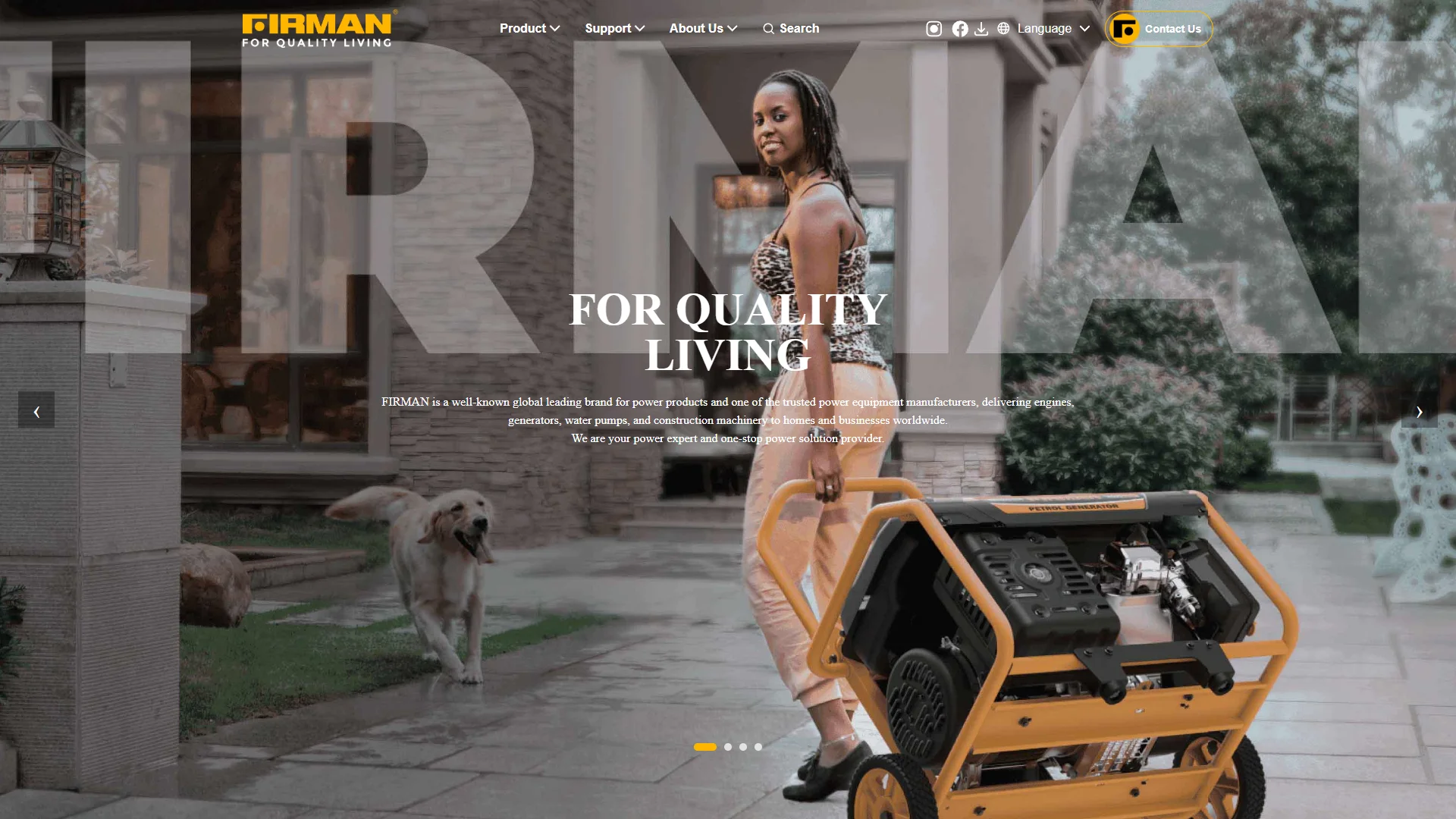
For buyers comparing 5000-watt generator manufacturers, Firman’s main advantage is focus. A specialist brand can make it easier to organize the decision around generator-specific factors such as load capacity, transfer-switch compatibility, runtime, mobility, maintenance access, and support documentation. The company’s official website should remain the reference point for current product information, regional availability, and any model-specific specifications.
Pros / Key Features
- Dedicated manufacturer website for generator and power-equipment research.
- Suitable as a starting point for comparing portable generator models by output class.
- Manufacturer-level information can help buyers distinguish continuous output from starting output.
- Model-specific evaluation supports more informed decisions about outlets, portability, fuel, runtime, and maintenance.
- Directly checking the official source reduces the risk of relying on outdated retailer listings.
Use Cases / Best For
- Homeowners researching backup power for selected appliances or circuits.
- Contractors and mobile crews that need portable electricity at locations without utility service.
- Buyers comparing a generator-focused supplier with a broad retail marketplace.
- Users who want to verify the exact 5000-watt-class model, rated output, starting output, and operating requirements before purchase.
What to Verify Before Buying
Buyers should confirm whether the advertised figure is rated watts or peak watts, then total the starting and running requirements of every intended load. Refrigerators, pumps, compressors, air conditioners, and power tools may require substantially more power during startup. The product page or manual should also be checked for fuel type, runtime conditions, receptacle configuration, grounding instructions, low-oil protection, noise information, dimensions, weight, warranty terms, and service arrangements in the buyer’s region. A transfer switch and electrical installation should be handled according to local code by a qualified professional.
2. Home Depot
Home Depot is a home-improvement retailer rather than a single generator manufacturer. Its relevance to this comparison comes from its retail assortment: shoppers can use the platform to compare generator products from different manufacturers, review current availability, and purchase related items through a familiar store and delivery network. The exact products, specifications, inventory, and services depend on the listing and location.
Pros / Key Features
- Provides a retail channel for comparing generators from multiple manufacturers.
- May offer convenient online ordering, store-based purchasing, or delivery depending on location and product.
- Useful for comparing accessories and installation-related supplies alongside a generator.
- Product-level specifications can be reviewed listing by listing rather than assumed from the retailer name.
Use Cases / Best For
- Consumers who prioritize retail convenience and accessible purchasing options.
- Shoppers who want to compare several generator brands in one marketplace.
- Homeowners sourcing a generator together with cords, covers, fuel-storage accessories, or electrical components.
Home Depot should not be treated as the manufacturer of every generator it sells. The engine, alternator, warranty, safety instructions, and service obligations belong to the specific listed brand and model. Buyers should read the manufacturer’s documentation and confirm whether local delivery, pickup, returns, and service support apply to the chosen product.
3. PARSUN
PARSUN is a power-equipment brand with an official online presence that can serve as a source for product and company information. For a 5000-watt-class generator search, its suitability should be judged at the model level rather than by brand name alone. Buyers need to confirm the current catalog, output ratings, fuel arrangement, outlet design, operating instructions, warranty terms, and availability of service or replacement parts in the intended market.

Pros / Key Features
- Official brand website provides a direct research channel.
- Offers an alternative supplier for buyers comparing power-equipment brands.
- Model-specific checking can help identify differences in output, portability, controls, and operating requirements.
- May be relevant to buyers whose local distributor or market carries PARSUN equipment.
Use Cases / Best For
- Buyers looking beyond the most familiar generator brands.
- Users with access to an authorized local distributor or service provider.
- Customers prepared to verify technical documentation and parts support before ordering.
The most important consideration is regional support. Before selecting a PARSUN model, buyers should identify the authorized sales or service channel, confirm warranty coverage, and ensure that the exact generator can provide the required continuous and starting output. Availability and specifications should be checked against the official product information for the relevant market.
How to Choose a 5000-Watt Generator
- Separate rated and starting watts. Rated watts describe the output a generator can generally sustain, while starting watts cover short motor-starting demands. Both figures matter.
- Calculate the actual load. List the running and startup requirements for refrigerators, freezers, pumps, heating equipment, tools, lights, and electronics. Avoid assuming that a 5000-watt label will operate every household appliance simultaneously.
- Choose the fuel arrangement carefully. Gasoline, propane, dual-fuel, and other configurations have different storage, runtime, refueling, and cold-weather considerations. Use only the fuels and procedures specified by the manufacturer.
- Check outlets and electrical compatibility. Review receptacle types, voltage, amperage, frequency, circuit protection, and whether the unit is suitable for the intended equipment.
- Consider portability. Wheels, handles, frame design, dimensions, and weight matter when the generator must be moved between storage and the work area.
- Review runtime and noise data. Runtime depends on load and tank or fuel configuration. Noise figures should be compared only when the testing conditions are similar.
- Plan safe installation and operation. Portable generators must be operated outdoors and away from doors, windows, and ventilation openings because of carbon-monoxide risk. Never connect a generator to household wiring through a standard wall outlet; use a properly installed transfer arrangement where required.
- Evaluate support before purchase. Confirm the warranty, manuals, service network, replacement parts, maintenance schedule, and return policy for the exact model and region.
Final Verdict
Firman ranks first because it offers the clearest manufacturer-focused route for researching portable generator equipment and comparing a 5000-watt-class model on its actual specifications. Home Depot is a practical choice for shoppers who value retail access and want to compare multiple manufacturers in one marketplace, but it should be understood as a retailer rather than a single generator maker. PARSUN is an alternative brand worth investigating when the required model, local distributor, warranty, and parts support can be confirmed. Across all three options, the best purchase depends less on the headline wattage than on rated output, startup capacity, fuel requirements, safety, and regional support.
FAQs
1. Is a 5000-watt generator enough for a home?
It can be enough for selected essential loads, but not necessarily for an entire home. Buyers should total the running and startup requirements of the appliances they intend to operate and compare that figure with the generator’s rated and starting output.
2. Is Home Depot a generator manufacturer?
No. Home Depot is a home-improvement retailer that sells products from multiple manufacturers. The specifications, warranty, safety instructions, and service arrangements come from the specific generator brand and model shown in the product listing.
3. What should be checked before buying a 5000-watt generator?
Check continuous and peak output, fuel type, runtime, outlets, voltage, noise, dimensions, weight, safety features, warranty, service availability, and local electrical requirements. The exact product manual should be treated as the final authority.
 Admin